INFO CENTER
ELIYA Linen - Professional Hotel Linen Manufacturer for One-Stop luxury hotel supplies purchasing Since 2006.
Language
ELIYA Linen - Professional Hotel Linen Manufacturer for One-Stop luxury hotel supplies purchasing Since 2006.
A single failed fire-safety inspection can leave you up against the wall the week before you even get to open your doors for the first time. The bedding was no doubt premium, the price seemed just about right, and then the order sailed through customs without a hitch. Only to have the local fire marshal come along and pull a mattress for a burn test - and next thing you know, your entire floor of rooms gets slapped with a red tag.
Compliance is one of those really, really important details in hotel buying that you don't even think about until suddenly it's an emergency. A hotel room looks beautiful with a gorgeous duvet, but unless you can say for certain it meets standards like CFR 1633 in the States or BS 7177 in the UK - well, it's all just a lot of show. And don't even get us started on the chemical safety - your legal team will have a field day combing through contracts line by line before they even sign off.
This is where the decision over sourcing high-end hotel bedding - which often seems to be just a style thing - suddenly involves a ton more than just looks. That beautiful fabric has to check the boxes on paperwork too, and if it doesn't, it's a whole lot more than just a fashion faux pas - it's your entire opening on the line.
Here's what we're going to cover below:
● What exactly do those fire-retardant standards - CFR 1633 and BS 7177 - actually require
● How OEKO-TEX certification can actually give you some real peace of mind on the chemical safety front
● Why it's not just a matter of a supplier claiming something verbally, but getting all the paperwork signed off - that's what your legal team is going to be looking for
● Some tips on how to be sure that your suppliers have the right certifications before you send them a single order
● The ins and outs of what paperwork is going to come with every big order you place
Lock these standards down early, and your opening day stays clear of red tags.

Flammability rules are not optional guidelines. They carry the force of law in the markets that enforce them, and a hotel that opens with non-compliant bedding exposes itself to shutdowns and liability. Two standards dominate the conversation for English-speaking markets, and they work differently enough that you need to know which one applies before you order.
CFR 1633 is the US federal standard governing the open-flame flammability of mattress sets. Administered under the Consumer Product Safety Commission, it measures how a mattress and foundation respond to an open flame over a 30-minute test. The standard caps the peak heat release and the total heat generated in the first ten minutes, which buys occupants time to escape before a fire grows uncontrollable.
For a buyer, the standard matters most at the mattress and foundation level, though the bedding layered on top plays into the overall fire load. Any property selling or operating in the US market must source mattress sets that carry CFR 1633 certification, with test records traceable to the production lot.
Here is what the standard covers in practice:
● Open-flame resistance measured against two burner ignition sources
● Peak heat release held under a defined ceiling during the test window
● Prototype testing that ties production units back to a qualified design
● Record retention requirements, so each lot stays traceable for audits
BS 7177 is the British standard classifying the ignitability of mattresses, divans, and bed bases. It sorts products into hazard categories based on the setting they serve, which is the detail that trips up buyers who treat all UK bedding as one tier. A budget hotel and a high-security hospital respond to different ignition sources under the same standard.
The classification system runs across four levels of severity:
1. Low Hazard, covering general domestic use
2. Medium Hazard is the level most hotels and motels must meet
3. High Hazard, for hospitals, nursing homes, and similar settings
4. Very High Hazard, reserved for prisons and secure accommodation
Most hospitality projects in the UK land at the Medium Hazard tier, which tests against a smouldering cigarette and a lit match equivalent. Confirm the category your property type requires with your local authority before you place the order, because sourcing the wrong tier is as costly as sourcing none at all.
Pro tip: Match the standard to the destination market, not the factory's location. A factory in Asia can produce to CFR 1633, BS 7177, or both at once, but only if you specify the target market in your tech pack from the start.
Fire performance protects guests from flame. OEKO-TEX protects them from what the fabric itself carries. This certification has become the baseline expectation for any high-quality hotel bedding sold into European and North American markets, and a legal team will flag its absence fast.
OEKO-TEX Standard 100 tests textiles for harmful substances at every stage of production, from the raw yarn to the finished sheet. A product earns the label only when every component, including the thread, the dye, and any coating, clears the limit values for a long list of regulated chemicals.
The testing screens for substances that pose a risk through skin contact and prolonged use:
● Azo dyes that can break down into harmful compounds
● Formaldehyde is used in some wrinkle-resistant finishes
● Heavy metals such as lead and cadmium in pigments
● Pesticide residues carried over from natural fibers
● pH levels that could irritate skin on contact
A sheet that touches a guest's skin for eight hours a night sits in a category regulators watch closely. An OEKO-TEX label tells your legal reviewer the product cleared independent lab testing rather than a supplier's own assurance. That distinction carries real weight when a procurement contract goes under review.
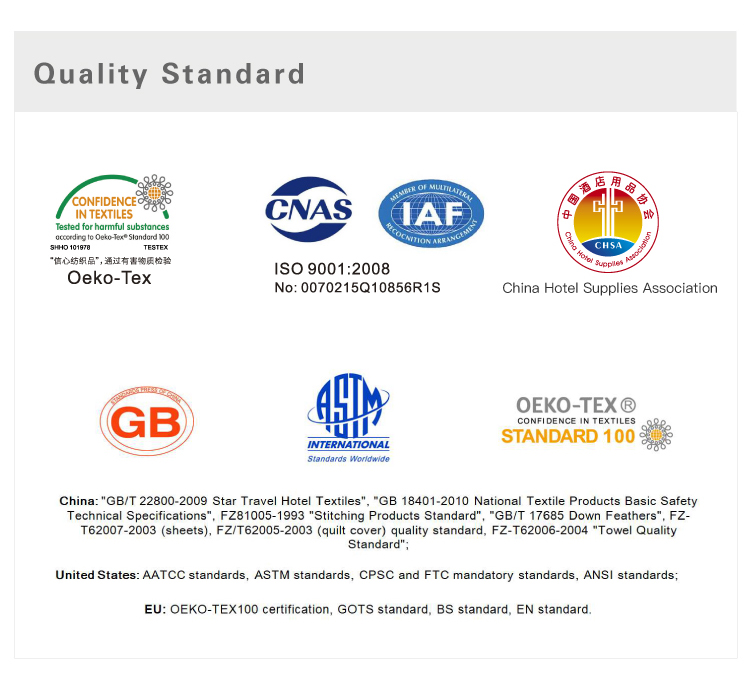
Engineering and procurement teams do not accept verbal compliance claims. They review certificates, test reports, and traceability records, because their own liability rests on that paper. A supplier who says the bedding "meets all standards" without producing the documents has told you nothing a lawyer can use.
The gap between a claim and a certificate is where projects get exposed. A certificate names the testing body, the standard, the test date, and the specific product it covers. A verbal claim names none of those, which makes it worthless the moment an inspector or an insurer asks for proof.
Genuine compliance arrives as a paper trail you can verify independently. Each document below answers a question your legal team will raise.
● Test reports from an accredited third-party laboratory, naming the standard and the date
● Certificates of compliance tied to the specific product and production lot
● Traceability records linking the certificate to the goods you actually receive
● Material declarations listing fabric composition, GSM, and any treatments applied
A certificate is good for nothing on its own, so make sure you research the place that issued it. Check the lab's accreditation, make sure the certificate number is still current, and that the description of the product matches what you actually ordered. For example, OEKO-TEX certificates have a number on them that can be directly checked through the issuing organisation's online database.
Do the maths on the dates as well - a certificate that expired two years ago is not going to cover materials used in this year's production run - and some bright spark in your business will catch that discrepancy even if your team responsible for sourcing misses it.

The strongest signal a supplier sends is the ease with which they hand over their paperwork. A factory geared for engineering projects keeps current certificates on file and produces them on request without friction. Hesitation or vague answers tell you everything you need to know.
Run any shortlisted supplier through this verification sequence before you commit:
1. Request the full certificate set for your target market up front
2. Confirm that each certificate names an accredited testing body
3. Validate certificate numbers through the issuing institute, where possible
4. Match the product description on the certificate to your exact order
5. Ask how compliance carries through to reorders and later phases
A supplier producing high-end hotel bedding for regulated markets treats this process as routine. Eliya Hotel Linen supplies properties across more than 130 countries and holds the certifications that legal reviews demand, including ISO 9001 quality assurance, which is the kind of documented backing that lets an engineering team sign off without hesitation.
Doing your homework on the supplier at the very start of the process gives you peace of mind once. But putting compliance requirements right into your purchase agreement means you are protected right through to the time the order is actually fulfilled. Make sure to specify exactly which standards need to be met and what certificates need to be shown. And make clear in the agreement that acceptance of the goods depends on proving they do meet the required standards.
That one simple clause does a couple of useful things for you - it gives you a leg to stand on if the goods delivered do fall short & also sends a clear signal to the supplier that this paperwork isn't something they can just waltz in and not bother with. Both of those protections cost nothing to add to the contract and can save you a small fortune if a disagreement ever comes up.
Compliance is not a one-time check at the start of a relationship. Every bulk order needs its own current documentation, because certificates expire and production lots change. Treat the paperwork as part of the delivery, not an afterthought you chase later.
Demand this set with each shipment of high-quality hotel bedding:
● A current fire-retardancy certificate matching your market (CFR 1633 or BS 7177 at the correct hazard tier)
● A valid OEKO-TEX certificate covering the exact fabrics in the order
● Third-party test reports dated within the certificate's validity period
● A material specification sheet confirming composition, weight, and finishes
● Lot traceability linking the documents to the goods on the truck
Keep these records on file for the life of the product. When a fire marshal, an insurer, or an auditor comes asking, you produce the file in minutes rather than scrambling to source it from a factory across an ocean. That readiness is what separates a project that passes inspection from one that opens late.
You now know exactly what stands between a smooth opening and a red-tagged floor. Compliance is paperwork backed by performance, and you can demand both before a single piece ships. Fire-retardant certification matched to your market, OEKO-TEX clearance on chemical safety, and a verifiable document trail turn the riskiest part of hotel buying into a controlled checklist you run on every order.
The next time a legal team asks for proof, you hand over a file instead of chasing a factory across an ocean. That readiness is what keeps your timeline intact and your liability covered. Eliya Hotel Linen produces bedding to the certifications regulated markets demand, so the documentation your reviewers need arrives with the goods rather than weeks after you ask.
Carry these essentials into your next sourcing round. Match the fire standard to the destination, whether that means CFR 1633 in the US or the correct BS 7177 hazard tier in the UK. Insist on a valid OEKO-TEX certificate covering your exact fabrics. Validate every certificate number through its issuing body. Write the standards into the contract, and demand current paperwork with each shipment.
Lock those steps in place, and your bedding clears inspection long before the first guest checks in.
Copyright © 2026 Guangdong ELIYA Hotel Linen. Co., Ltd - www.eliyachina.com All Rights Reserved.